Colonial auxiliaries or advocates of colonial subjects? A comparative view on chiefs and 'traditional rule' during the colonial period - 27/ 28 May 2010
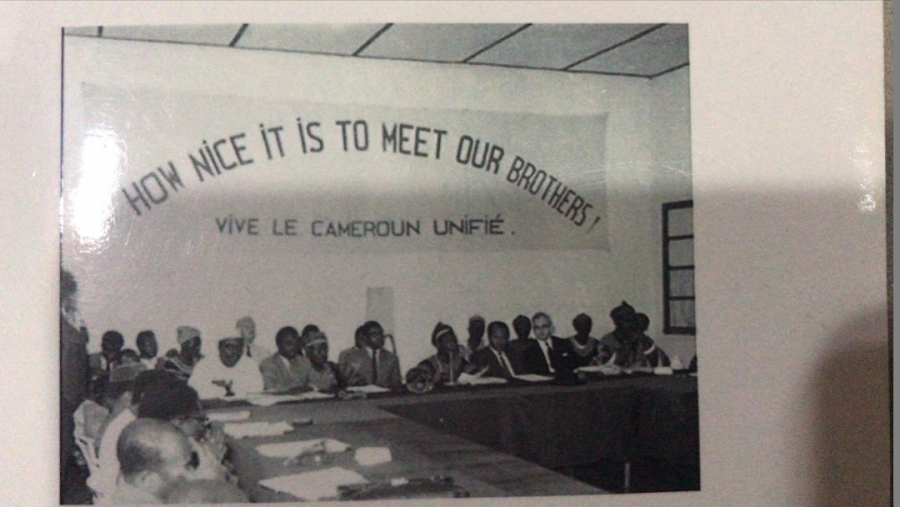
With the transfers of power in still-colonial sub-Saharan Africa, the époque of 'traditional chieftaincy' seemed to be finally over. The chiefs that had been regarded by 'modern' colonial officials, and by social scientists, as an outmoded product of either the colonial state, or of African 'despotism', appeared to lose all of their authority. Some of the more 'radical' postcolonial governments, like in Guinea-Conakry or in Tanzania, would engage to abolish 'traditional rule' altogether.
However, fifty years later, we are puzzled by the resilience of chieftaincy in many parts of the African continent. Moreover, it has to be asked what in the end had been the role of the 'traditional rulers' inside the late colonial states, and if the chiefs did not retain a good part of their room for manoeuvre. Did 'traditional rulers' learn how to 'play the game'? Can the 1940s and 1950s even be understood as a period in which they acquired the skills to survive after independence?
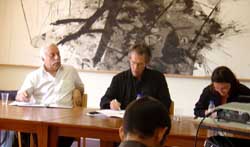
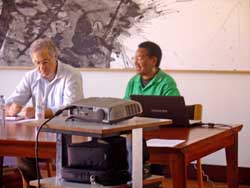
27th-28th May 2010
at the University of Porto, Portugal, organised by the Centre of African Studies (CEAUP).
This conference attempted to describe, from a comparative perspective, the role of the institution of chieftaincy under the colonial states. It will address a large number of subjects, those including:
" the role of the chiefs in tax enforcement and forced labour;
" chiefs as instruments of the colonial state, and their personal interest;
" the boundaries of chiefly activities;
" established dynasties vs. favourites of colonial administration: the mechanisms of succession;
" the role of the chiefs during decolonisation.
A selection of the most innovative conference papers will be published as a special issue of Africana Studia in December 2010.
Organising Committee
Dr Alexander Keese (CEAUP Porto)
Dr Manzambi Vuvu Fernando (Direcção Nacional de Museus de Angola & CEAUP Porto)
Programa / Program
Chiefs and decolonisation: opponents or fellow travellers?
27 de Maio de 2010
10h00 - Opening Session / Reception of participants
Sessão de abertura e distribuição da documentação aos participantes
10h30-11h00
Alexander KEESE, Introduction: The ‚traditional chiefs' and the politics of decolonisation in West Africa
11h00-11h15 - Cofee Break
11h15-12h00
Jean-Hervé JEZEQUEL (Université Bordeaux IV, France), Chiefs as Modernizers? Fily Dabo Sissoko, the 'Parti Progressiste Soudanais' and the Question of Independence in Mali (1930s-1964)
12h30-14h00 - Almoço / Lunch break
Painel 1/ Panel 1: Dynasties and traditional rights under colonial rule
14h00-14h45
Noah Echa ATTAH (Osun State University, Nigeria), Colonialism and the Demystification of Traditional Rulers in Nigeria
14h50-15h35
René OTAYEK (Centre des Etudes sur l'Afrique Noire, Bordeaux, France), La Chefferie Mossi au Burkina Faso : une mise en perspective historique vue par un politologue
15h40-16h25
Louise MULLER (University of Utrecht, Netherlands), The Persistence of Asante Chieftaincy in the Colonial Period (1896-1957): explanations for an enigma
16h30-17h00 - Coffee break
Painel 2/ Panel 2: Chiefs and Religious Movements - convergences and alternatives
17h00-17h45
Maurice Soudieck DIONE (Centre d'Etudes sur l'Afrique Noire, Bordeaux, France), La préservation et la perpétuation de l'ordre sociopolitique impérial au Sénégal: une collusion stratégique d'intérêts entre les marabouts et le colonisateur
17h45-18h30
Eduardo COSTA DIAS (CEA-ISCTE, Lisbon), Chefs 'traditionnels' et mouvement religieux en Guinée-Bissau
28 de Maio de 2010
Painel 1 / Panel 1: Propriety, Legal Structures, and the Memory of Chiefly Roles
9h30-10h15
Rosalie KIAH (Norfolk State University), The Role of the Traditional Chieftaincy in Promoting Culture and Development: Perspectives from Botswana, Ghana and Zimbabwe
10h15-10h30 - Coffee Break
10h45-11h15
Maria Paula MENESES (Universidade de Coimbra), Legal Pluralism and Plural Memories: a View from Mozambique
11h15-12h00
João MADEIRA (Centro de Administração e Políticas Públicas - CAPP), The traditional property on Bijagos islands of Guinea-Bissau during the colonial and post-colonial period.
12h00-12h45
Madalina FLORESCU (SOAS, London, United Kingdom), Methodological and Epistemological Considerations of a Historical Ethnographic Approach to the Role of Chiefs in the Decolonization Process in Luanda
13h00-14h30 - Almoço / Lunch Break
Painel 2 / Panel 2: Tax collectors of the system?: chiefly roles in taxation and forced labour
14h30-15h15
Philip HAVIK (IICT, Lisbon), Association or indirect rule: reinventing sovereignty and appointing Chiefs in Portuguese West Africa
15h15-16h00
Patrice PAHIMI (ENS, Université de Maroua, Cameroon), Cultures de Rente et Evolution Politique des Chefs Traditionnels de l'Extrême-Nord Cameroun pendant la Colonisation
16h00-16h30 - Coffee Break
16h30-17h15
Jean GORMO (ENS, Université de Maroua, Cameroon - CEAUP, Porto), Les Chefs Locaux et le Recouvrement Fiscal au Nord-Cameroun Colonial et Postcolonial : Cas de la Plaine du Diamaré et des Monts Mandara
17h15-18h00
Maciel SANTOS (CEAUP, Porto): The Indigenous Chiefs and the implementation of the 'hut tax' in Angola - peculiarities of the Lunda case (1912-31).
18h15-19h00
Eric ALLINA-PISANO (University of Ottawa, Canada), Enforcing Orders 'given by the Muzungus': Chiefly interests and colonial power in central Mozambique, c. 1890-1935
19h00 - 20h00 - Debate final / Debate
Fotos do evento: